

Choosing a platform for your business website is a bigger decision than it first appears. It shapes your upfront costs, how much flexibility you have, how easily you can grow, and how much time you’ll spend on maintenance down the track. Get it right, and your website becomes an asset that supports your business for years. Get it wrong, and you could be facing costly rebuilds or frustrating limitations.
Two of the most common paths are building a custom website from scratch or using WordPress. Both can produce a great result. The trick is knowing which one suits your goals, your budget, and where your business is heading. Let’s break down what each option involves and who they tend to work best for.
What Is a Custom Website?
A custom website is built specifically for your business from the ground up. Rather than starting with a template, a developer designs and codes the site around your exact needs.
Here’s what that usually means in practice:
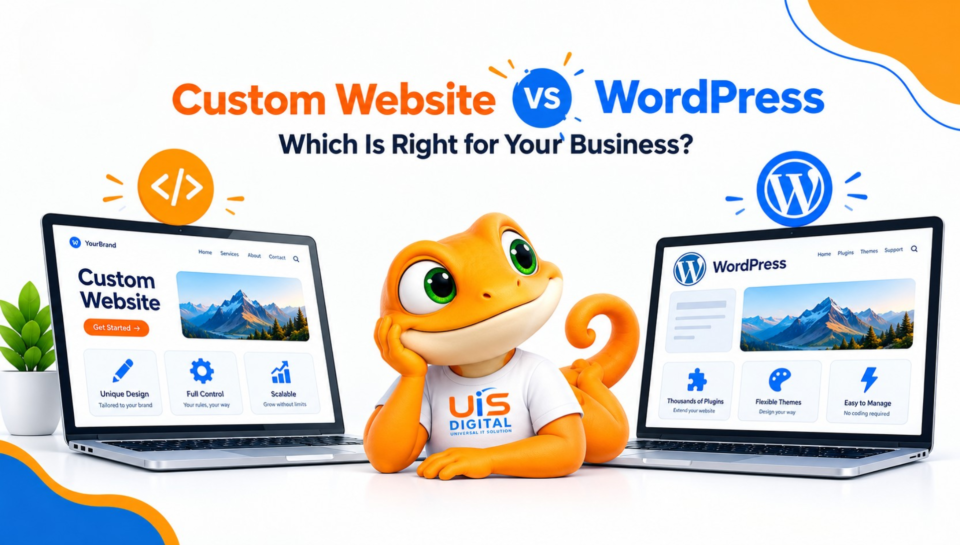
- Bespoke design: Every element is designed for your brand, so your site looks and feels unique rather than off-the-shelf.
- Greater flexibility: You’re not boxed in by a theme’s limitations. If you can imagine it, a developer can usually build it.
- Custom functionality: Need a booking system, a customer portal, or a specific integration? Custom development lets you build features that fit your workflow.
- Scalability: A well-built custom site can expand and adjust as your business evolves.
The trade-off is that custom website development often takes more time and comes with a greater upfront cost, since everything is built specifically for you.
What Is a WordPress Website?
WordPress is one of the most popular platforms in the world for building business websites. It uses a content management system that makes it relatively easy to create, edit, and manage a site without deep technical knowledge.
The main drawcards include:
- Easier content management: Updating pages, adding blog posts, or swapping images is simple for most business owners.
- Faster development: Because you’re working with existing themes and tools, sites can often be built more quickly.
- A huge range of themes and plugins: There are thousands of ready-made designs and add-ons to extend what your site can do.
- Lower initial development cost: For many businesses, WordPress website development is more affordable to get started.
Keep in mind that WordPress sites need persistent attention. Themes and plugins require regular updates, and neglecting them might result in security or performance issues.
Custom Website vs WordPress: Key Differences
Here’s a side-by-side look at how the two options compare across the factors that matter most.
| Cost | Higher upfront investment | Lower initial cost |
| Development time | Longer, built from scratch | Faster with themes and tools |
| Design flexibility | Fully tailored to your brand | Limited by theme (though customizable) |
| Functionality | Built to your exact needs | Extended through plugins |
| Scalability | Designed to grow with you | Scalable, but may hit limits |
| Maintenance | Managed by your developer | Regular updates needed |
| Ease of use | Varies by build | Generally beginner-friendly |
Which Option Is Right for Your Business?
The best choice depends on where your business sits today and where you want it to go.
Small and service-based businesses that need a professional, reliable website free of complex features often find WordPress a practical, cost-effective fit.
Startups watching their budget may prefer WordPress to launch quickly, then reassess as they grow. That said, a startup building something genuinely unique might benefit from custom development early on.
Growing businesses that are outgrowing their present setup may find a custom website gives them the flexibility and expandability they need.
Businesses requiring unique systems or integrations — such as tailored booking tools, member portals, or connections to other software — usually get better results from custom development.
E-commerce businesses could succeed with either approach. WordPress handles many online stores well, while high-volume or highly specialized shops may need the control a custom build offers.
Final Thoughts
Neither a custom website nor WordPress is automatically the better choice. The right platform comes down to your business goals, your budget, the functionality you need, and your plans for the future. A small service business and a fast-scaling tech startup will often land on very different answers, and that’s perfectly fine.
At UIS Digital, we help Australian businesses choose and build the right website for their needs. Whether you need a flexible WordPress website or a fully customised solution, our team can help you find an approach that fits your goals, budget and plans for growth.
The most useful thing you can do is get clear on what you want your website to achieve before you commit. If you’re weighing up your options, it can help to talk it through with an experienced web development team like UIS Digital, who can look at your specific situation and recommend the approach that makes the most sense for your business.